|
|
|
|
POSPET - Who, What, and Why
The Pacific Oil Spill Prevention Education Team, POSPET, evolved from the simple premise that small oil spills can add up to cause significant environmental and economic harm, and are a regional problem that can be remedied more effectively through collaborative projects drawing from existing talent and resources. For over a decade, POSPET has served as a forum for exchanging information and outreach ideas about prevention of oil spills and other boater best management practices while providing boat and marina operators with a consistent and accurate pollution prevention messages. POSPET members include representatives from state and federal agencies, industry associations, and nonprofit groups from Alaska, British Columbia, Washington, Oregon, California, and nationwide.
POSPET encourages networking to exchange ideas and to help its members adopt innovative approaches, while avoiding inefficient replication and pitfalls in their respective pollution prevention programs. Through informal collaboration and access to beneficial member review and feedback, POSPET adds value and has improved the quality and reach of individual efforts.
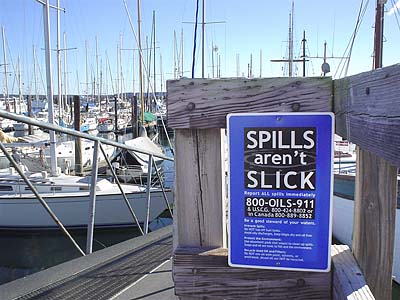
POSPET also allows for the effective leveraging of resources. The cooperative spill prevention campaign that uses the "Spills Aren't Slick" message ensures the widest distribution of educational materials while saving all POSPET members on material, design and production costs.
POSPET has also been instrumental in promoting an easy-to-remember phone number to encourage spill reporting. The 1-800-OILS-911 number can be called from anywhere in British Columbia, Washington, Oregon, or California, and the reporting of an oil spill is automatically routed to the correct emergency response dispatch center in any of those jurisdictions. The Pacific States/BC Oil Spill Task Force provides staff support for POSPET and maintains this innovative spill reporting number.
read more (pdf file 31kb)
click here for a list of POSPET Members (pdf file 245kb)
A Spills aren't Slick sign posted at Port Townsend Marina in Washington.
As part of Georgia Strait Alliance's presence at the 2007 Vancouver International Boatshow, "SPILLS aren't SLICK" information was readily available as a compliment to their "Creating Cleaner Harbours" Bilge Pad Kit distribution project.
|
|
|
|
PDF files for the Spills Aren't Slick materials
These PDF files provide the graphics for the Spills Aren't Slick signs and decals which are distributed by POSPET members. Credit for the design goes to Tom Leonard, Graphic Designer for the Washington Department of Ecology. The official POSPET signs are printed on 11" x 18" poly-plastic, fade resistant material for posting outdoors at boat ramps and marinas, but if you wish to reprint for indoor use, please do so. Please note that the spill reporting numbers on the decals differ for British Columbia/Washington waters and Oregon/California waters.
Poster (pdf file 24kb)
Decal for Canada (pdf file 64kb)
Decal for U.S. (pdf file 64kb)
Brochure (pdf file 1.8 MB)
|
|
|
Check out the Official Sea Shanty of the Georgia Strait Alliance's Bilge Pad Project: http://www.georgiastrait.org/?q=node/767
A POSPET FEATURED PROGRAM
POSPET provides a forum for members to exchange information on successful outreach and education efforts. California's Boating Clean and Green program has been an outstanding source of good ideas and information, as you can see below:
The Boating Clean and Green Program is a statewide boater education and technical assistance program conducted by the California Department of Boating and Waterways and the California Coastal Commission that promotes environmentally sound boating practices to marine business and boaters in California. Started in April 1997, the Program conducts boater education throughout the state in partnership with many public and private agencies that share a goal of educating boaters about environmentally sound boating practices.
Protecting our waterways and making the boating environment one that is safe and enjoyable has an enormous statewide impact. Boating is one of America's most popular pastimes, and in California, recreational activity is on the rise, pumping millions of dollars into California's economy. There are more than 900,000 boats registered in the state and an estimated 3 million people actively boat each year on California's numerous waterways. As more people become involved in boating, there is a need for more environmental boating education and technical assistance to marine businesses to provide the boating community with convenient pollution prevention services and resources.
Through successful partnerships with marine businesses, boating associations, environmental and non-profit groups, state and local governments, including the Keep the Delta Clean Program, the Program educates boaters about environmentally and safe sound boating while assisting marinas and local governments in identifying the need for and installing pollution prevention services for boaters.
Since 1997, the Program has received funding from several federal, state and local agencies including: the California Integrated Waste Management Board (CIWMB), the Environmental Protection Agency, the National Oceanic and Atmospheric Administration, Contra Costa County Public Works and staff support from the San Francisco Bay Conservation and Development Commission.

The Boating Clean and Green Program (BC&G) performs a critical function by serving as a statewide point of contact for clean boating education and technical assistance. BC&G's dual strategy of providing boater education and working to ensure that boaters have access to the tools and convenient facilities to make it simple to boat cleanly has filled an important niche. A key facet of BC&G involves partnerships with marinas and other marine businesses, boating associations, environmental nonprofit groups and government agencies. Through partnerships with these stakeholders, the BC&G has been working successfully on these issues for over nine years. BC&G's main accomplishments generally fall within the categories of research, outreach/public education, and technical assistance.
- Research: The BC&G has conducted research to gain an informed understanding of the obstacles to reaching more effective clean boating, to assess the needs for services, and to evaluate the Campaign's success.
Efforts to date have included: 1) a measurement and evaluation plan; 2) a survey of boat maintenance practices and attitudes of California boaters; 3) an investigation of educational approaches for motivating boaters to change behavior; and 4) a needs assessment study to identify existing marina-based environmental services (sewage and bilge pumpouts, used oil recycling, oil absorbent exchange programs) and facilities, and to identify geographic gaps in those services. Currently, the program is conducting a Boater Questionnaire. The Boater Questionnaire is a critical component of the program as the information collected will ensure the BC&G can continue to improve the program over time. The Questionnaire provides understanding about boaters' activities on the water and during boat maintenance, helps identify gaps in environmental services and identifies new opportunities to improve access to clean and safe boating information in California.
 |
| Boater Kit |
- Education (Recreational Boater and Marine Business Education and Outreach): The BC&G conducts direct outreach to boaters and marine business operators, provides educational materials and tools for others boater education efforts, and trains volunteer educators to perform boater-to-boater education. Tasks completed to date include the following:
- Developed and distributed over 80,000 clean boating kits (The boater kit is a bag filled with educational materials and promotional items for boaters. The kit includes an organic tote bag, a tide book, a safety flag, Department of Boating and Waterways pamphlets (ABC's of the California Boating Law, Clean Boating Habits and Personal Floatation Devices), oil absorbent pillow with reusable zip tie and instructions and more.
- Hosted an educational booth at more than 70 boat shows and events (3-5 minutes spent with each boater conducting face-to-face- education, approx. 300 boaters per boating event.
- Trained over 500 volunteer Dockwalkers statewide to educate the boating community about clean and safe boating practices.
- Installed 450 clean boating education signs at boat launch ramps (English and Spanish).
- Installed 150 signs promoting clean fueling practices at fuel docks (English).
- Distributed 600 "Shopping Clean and Green" point-of-purchase displays at marine supply shops.
- Developed and distributed over 20,000 copies of the "Boat Maintenance Checklist"
- Communicate with general public via media-published numerous articles, advertisements and press releases (average 5-6 per year).
- Developed and distributed over 3,600 posters to marine business promoting clean and safe boating practices.
- Published and distributed the Northern and the Delta sections of the quarterly Changing Tides newsletter (as part of the California Clean Boating Network). 40,000 issues distributed per year (in partnerships with all CCBN chapters statewide; circulation of over 10,000 subscribers per issue).
- Created a clean boating website (http://www.coastal.ca.gov/ccbn/ccbndx.html). Over 11,000 hits per year.
- Developed and distributed more than 40,000 Tidebooks with charts identifying clean boating services at marinas in CA and promoting clean boating practices.
- Developed and maintained the first nationwide clean boating interactive information system on the 1(800) CLEANUP hotline and Earth's 911 website. Over 40,000 hits per year.
- Developed clean boating information for NOAA nautical charts.
- Developed and Distributed in partnership with the Keep the Delta Clean Program (KDC) over 43,000 copies of the "Sacramento-San Joaquin Delta Map for Recreational Boaters"
- Developed and distributed in partnership with the San Francisco Baykeepers more than 1,500 copies of the "Clean Boating Guide For San Francisco Bay Map."
- Developed and distributed in partnership with Project GreenWorks more than 500 copies of the "Huntington Harbor and Newport Beach Clean Boating Maps"
- Developed and distributed in partnership with the Santa Monica Bay Restoration Foundation over 40,000 "Southern California Boater's Guide."
- The BC&G is an active member of more than five networking groups, including: Interagency Coordinating Committee-Marinas and Recreational Boating Workgroup; Copper Antifouling Paint Sub-Workgroup of the Marina and Recreational Boating Workgroup; Central California Seabird Colony Protection Program; the Resource Management Working Committee of the San Francisco Bay Subtidal Habitat Goals Project; the Pacific Oil Spill Prevention Education Team and the Clean Marinas California Program
 |
| Program Volunteers |
- Technical assistance: The BC&G provides technical assistance to marina operators and local clean boating programs, both by providing tools for local outreach efforts and helping to get the needed environmental services installed. Technical assistance efforts include the following:
- Developed the California Clean Marinas Toolkit (Over 660 toolkits distributed to date).
- Developed the California Marinas and Boating Facilities GIS database and provided access to GIS maps of marina environmental services. The database is used by others to develop local marina and recreational boating maps (Items 14-17 above);
- Continued facilitating for the Northern and the Delta California Chapters of the California Clean Boating Network (CCBN). Assisted the Santa Monica Bay Restoration Foundation to start the Southern Coast CCBN Chapter. (Over 400 CCBN Members).
- Developed and successfully held a clean boating conference. Also presented and participated as a panel member sharing the BC&G’s messages and successes at over 30 conferences and trade shows.
- Organized, Facilitated and conducted free marina operator workshops (Hazardous Materials/Substances Emergency Response First Responder Operational (HAZWOPER) Training and Invasive Species Prevention) with over 100 participants.
- Provided one-on-one technical assistance to local government agencies, marina industry representatives and harbor masters as requested. To date, more than 120 organizations and marine business have received technical assistance with setting up environmental services, pollution prevention infrastructure site and design, and local boater education efforts.
- Provided technical assistance to more than 10 partners nationwide and internationally setting up their clean boating and volunteer programs (i.e, Oregon, Washington, Arizona England and Australia).
- Partnered with Contra Costa County Public Works Department in developing and implementing Phase I and II of the KDC program including setting up environmental services and pollution prevention infrastructure at twenty five marinas in the Delta. The environmental services installed include:
- 2 fish cleaning stations,
- 55 pet waste stations,
- 17 cigarette butt receptacles,
- 15 information kiosks,
- 6 Oil Recycling Centers,
- 15 Oil Absorbent Exchange Centers,
- 15 fishing line recycling stations,
- 60 recycling bins (glass, aluminum, cardboard, plastic),
- 108 leak-proof dock boxes, and a wide variety of informational signage that accompanies all installed infrastructure.
Noted below are the estimated amounts of hazardous materials collected through the environmental services outlined above. It is important to note that the potential for materials collected at these sites continues to increase, as the numbers below represent the services prior to their promotion. The BC&G and the KDC Programs expect these numbers to rise as these programs expand to include more marinas, and increasing numbers of boaters learn about the programs.
- 8,135 - Gallons of used oil reclaimed (not including oil filters and oil absorbents)
- 5,490 – Pounds of Used oil filters collected.
- 4,040 – Pounds of used oil absorbents collected
- 1,143 - Pounds of oil absorbent polypropylene fiber recycled
- 360 - Gallons of used oil reclaimed from used oil absorbents
- 143 - Additional gallons of used oil reclaimed from used oil filters
- 1,251 - Marine engine batteries collected
Note: One pint of oil can produce a slick of approximately one acre on the surface of the water. One gallon of oil can ruin a million gallons of drinking water (U.S. EPA).
Currently, the BC&G is installing 44 fishing line recycling stations in the areas of California with the highest fishing activity. Some of the locations include: Berkeley Marina, Eureka Public Marina, Crescent City Harbor District, Clipper Yacht Harbor, Dave's Launch Ramp at Rainbow Marina (Long Beach), Moss Landing Harbor District, Sunset Aquatic Marina, Dana Point Harbor, Port of San Diego (San Diego Bay), Santa Cruz Harbor, West Side Parks (Sonoma County Regional Parks) and Channel Islands Harbor. Program staff is partnering with the BoatU.S Foundation in this effort. The BC&G will track down the amount of monofilament collected at each station. This information will be included in a nationwide tracking system.
 |
| Step-on Can and Stand |
To the extent feasible, the BC&G develops both qualitative and quantitative objectives. Each program task has its own performance measurement (evaluation criteria). For example:
- Dockwalkers training evaluation form
- number of volunteer Dockwalkers trained;
- number of boater kits distributed;
- number of boaters reached;
- number of boat shows and boating events attended;
- average number of participants at quarterly CCBN meetings;
- number of publications distributed;
- number of hits on both the Earth911.org and the program’s website;
- list of local governments, marinas and non-profit groups assisted;
- list of meetings attended and presentations conducted, among others.
AWARDS
The BC&G has received the following awards:
- 2008 Environmental Leadership Commendation provided by the BoatUS Foundation
- 2005 Outstanding Comprehensive Conservation and Management Plan Implementation Project awards from the San Francisco Estuary Project.
- The 2004 Excellence Program Award given by the Cal/EPA’s Household Hazardous Waste/Used Oil Program conducted by the California Integrated Waste Management Board.
$1,457,905 in total grant value awarded to the BC&G from Federal and State grants since the year 2000.
MAJOR CAMPAIGN STAKEHOLDERS
A key facet of the BC&G involves partnerships with marinas and other marine businesses, boating associations, environmental non-profit groups, and government agencies. California’s boating and environmental community stakeholders provide
valuable support that helps in the successful implementation of the Campaign. Through the California Clean Boating Network, the Campaign collaborates with over 200 organizations statewide. BC&G partners include: the Santa Monica Bay Restoration Foundation;
San Francisco Bay Conservation and Development Commission; US Coast Guard Auxiliary; West Marine; Clean Marinas California Program; BoatU.S Foundation; US Power Squadrons; Pacific Oil Spill Prevention Education Team; Northern California Marine Association;
Recreational Boaters of California; Pacific Inter-Club Yacht Association; various water keeper organizations; California Port Captains and Harbormasters Association; Marina Recreation Association; city and county used oil and storm water programs including
Contra Costa, San Joaquin, Alameda, Napa and Los Angeles Counties; and many individual marina operators and boaters.
The Boating Clean and Green website is http://www.coastal.ca.gov/ccbn/ccbndx.html
For more information, contact:
Vivian Matuk, Environmental Boating Program Coordinator
California Department of Boating & Waterways
California Coastal Commission
45 Fremont Street, Suite 1900
San Francisco, CA 94105
Phone: (415) 904-6905
Fax: (415) 904-5216
|
|
|
SUMMARY NOTES
Pacific Oil Spill Prevention Education Team (POSPET)
2009 Fall Meeting
September 30, 2009
Hosted by the Washington Department of Ecology
Lacey, WA
Read more (pdf file 436 kb)
|
|
|
POSPET - Summary Notes of the March 17th, 2009
Summary Notes
Pacific Oil Spill Prevention Education Team (POSPET) Meeting
Hosted by the Oregon Department of Environmental Quality
Read more (pdf file 164 kb)
|
|
|
POSPET - Summary Notes of the October 7th, 2008
Summary Notes
Pacific Oil Spill Prevention Education Team (POSPET) Meeting
Washington Department of Ecology
Read more (pdf file 1.2 MB)
|
|
|
POSPET - Members' Contact Information
POSPET Members (pdf file
68kb)
|
|
|
POSPET - Summary Notes of the March 20th, 2008
Summary Notes
Pacific Oil Spill Prevention Education Team (POSPET) Meeting
2008 Spring meeting
Washington Department of Ecology
Read more (pdf file 56kb)
|
|
|
POSPET - Summary Notes of the October 16, 2007
Summary Notes
Pacific Oil Spill Prevention Education Team (POSPET) Meeting
Fall Meeting, October 16, 2007
Washington Department of Ecology
Read more (pdf file
64kb)
|
|
|
POSPET - Summary Notes, March 29, 2007
Summary Notes
Pacific Oil Spill Prevention Education Team (POSPET) Meeting
March 29, 2007
Washington Department of Ecology
Read more (pdf file
128kb)
|
|
|
Summary Notes October 2006 POSPET Meeting
Summary Notes
Pacific Oil Spill Prevention Education Team (POSPET) Meeting
October 12, 2006
Washington Department of Ecology
Read more
(pdf file 72kb)
|
|
|
POSPET - Summary Notes, March 9 2006
Summary Notes
Pacific Oil Spill Prevention Education Team (POSPET) Meeting
March 9, 2006
Washington Department of Ecology
Read more (pdf file
63kb)
|
|
|
Summary Notes October 2005 POSPET Meeting
Summary Notes
Pacific Oil Spill Prevention Education Team (POSPET) Meeting
October 11, 2005
Washington Department of Ecology
read more
(pdf file 106kb)
|
|
|
Summary Notes April 2005 POSPET Meeting
Summary Notes
Pacific Oil Spill Prevention Education Team (POSPET) Meeting
April 1, 2005
Washington Department of Ecology
read
more (pdf file 78kb)
|
|
|
Summary Notes October 2004 POSPET Meeting
Summary Notes
Pacific Oil Spill Prevention Education Team (POSPET) Meeting
October 19, 2004
Washington Department of Ecology
read more (pdf file
94kb)
|
|
| |
|
|
|
|
|